Erase speed and retention trade-offs in TANOS stacks
Why faster erase does not always mean better retention, and how the nitride layer and tunneling oxide set the balance in TANOS memory cells.

In TANOS memory cells, the erase step and the retention step pull in opposite directions. Erase wants charges to move quickly through the tunneling oxide and into the nitride. Retention wants those same charges to stay put for years. Engineers talk about this as a trade-off because steps that speed up erase can also open paths for charge to leak away later. This explainer walks through the field, the charge movement, and the material choices that shift the balance. If you are new to the topic, it is a good warm-up before our next seminar on trap layer comparisons.
What TANOS means and where charge lives
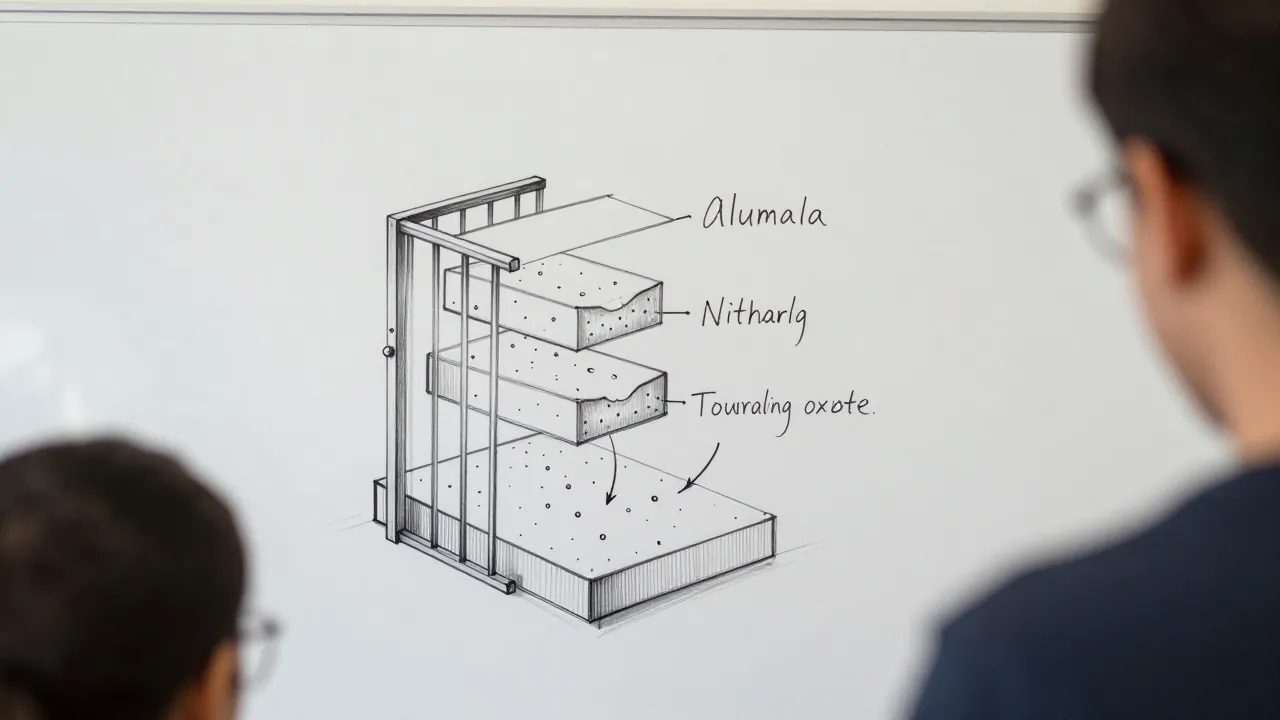
TANOS is a charge trap flash stack. The letters stand for the layers from top to bottom: tantalum nitride as the metal gate, alumina as the blocking oxide, silicon nitride as the trapping layer, a thin silicon oxide as the tunneling oxide, and silicon as the substrate. The nitride is not a conductor. It is full of traps, which are small energy wells where electrons can sit.
In a programmed cell, electrons fill those traps. The cell reads as a one. In an erased cell, the traps are emptied, and the cell reads as a zero. Erase is not a passive process: we apply a voltage that pushes electrons out of the nitride, usually back toward the substrate. The speed of that step depends on how easily electrons can move through the tunneling oxide and how many traps are available to empty.
Retention is the opposite measurement. After programming, we bake the cell or simply wait, and we watch how much charge leaves the nitride over time. A good cell keeps its charge for years. A poor one drifts after days or weeks. The same nitride that makes erase possible is also the layer that must hold the charge. That tension is the heart of the trade-off.
Why faster erase can shift retention
Erase speed is mostly about the tunneling oxide and the nitride trap depth. A thinner tunneling oxide lets electrons move more easily in both directions. That helps erase, because electrons can leave the nitride faster. But it also helps retention loss, because electrons can drift back through the same oxide when the cell is supposed to be holding its state. The oxide is a door. Making the door wider speeds up traffic in both directions.
Trap depth matters too. Shallow traps release electrons easily, which can speed up erase. But shallow traps also let electrons escape during retention, especially at warm temperatures. Deep traps hold electrons firmly, which helps retention but can make erase slower or require higher voltages. Nitride engineering, which means changing the composition and deposition of the nitride layer, is one way to adjust this balance.
A third factor is the blocking oxide and the sealing layer. The alumina on top is meant to stop charge from escaping toward the gate. If that layer is thin or damaged, retention suffers even when erase looks good. In our own spring tests, we saw that small changes in the sealing layer changed retention curves more than expected, which is why we now check numbers twice before posting results. The point is simple: erase speed alone is not a complete picture of cell health.
| Stack change | Effect on erase | Effect on retention |
|---|---|---|
| Thinner tunneling oxide | Faster | Usually worse |
| Shallower nitride traps | Faster | Usually worse |
| Thicker sealing layer | Little change | Often better |
| Deeper nitride traps | Slower | Often better |
Reading the trade-off in plain terms
Think of the nitride as a sponge full of small pockets. Programming fills the pockets with water. Erase squeezes the sponge. Retention is how well the sponge holds water when you are not squeezing it. A sponge with bigger holes empties faster but also leaks faster. A sponge with tighter holes holds water longer but takes more effort to empty.
In the lab, we measure both sides. Erase speed shows up as a shift in the threshold voltage after a fixed erase pulse. Retention shows up as a drift in threshold voltage after a bake at elevated temperature. When we change one layer, we look at both curves. A change that improves erase but flattens the retention curve is not a win. This is why our retention bake test guide starts with a baseline before any stack change.
One common misconception is that erase speed and retention are independent. They are not. They are linked by the same oxide and the same traps. Another misconception is that a faster erase always means a better cell. In TANOS, faster erase can be a warning sign that the tunneling oxide is too leaky. The useful question is not which cell erases fastest, but which cell meets both erase and retention targets at the same time.
What we watch in our own tests
- Erase time to reach a target threshold voltage window.
- Retention drift after a bake at a fixed temperature and time.
- Nitride trap energy depth from retention curves, which we read with a simple model.
- Sealing layer thickness and uniformity, because small changes show up in retention.
We keep these checks small and repeatable so that newcomers can join in. Our monthly online seminar often starts with a short review of these trade-offs before we look at new data. If you want to go deeper into the nitride itself, the open questions on nitride analysis are a good next read.
Why this matters for NAND cell design
In a NAND string, many cells share the same erase operation. If one cell erases too slowly, the whole block may need a longer pulse or a higher voltage, which stresses the other cells. If one cell retains poorly, the block may fail a retention check even when most cells are fine. Designers therefore tune the stack so that the slowest erase and the weakest retention are both acceptable across the block.
This is also why material analysis matters. A nitride layer that looks uniform on paper can have local variations in trap depth or composition. Those variations show up as spread in erase speed and retention across cells. Our notes on reading retention curves from trap energy explain how to spot that spread without expensive tools.
The practical takeaway is to treat erase and retention as a pair. When you change a layer, measure both. When you compare lots, compare both. When you read a paper, look for both. The trade-off is not a flaw in TANOS. It is the design space, and understanding it is how we make better cells.
Questions people ask
Does faster erase always mean worse retention?
Not always, but often. Faster erase usually comes from a thinner tunneling oxide or shallower traps, both of which can let charge escape during retention. A well-designed stack can improve one without hurting the other, but you need to measure both to know.
What is the nitride trapping layer doing?
The nitride holds electrons in small energy wells called traps. Those traps store the cell state. Their depth and density affect how easily electrons enter during program, leave during erase, and stay put during retention.
Why do sealing layers show up in retention tests?
A sealing layer helps block charge from escaping toward the gate. Small changes in its thickness or quality can change retention curves without changing erase speed much, which is why we watch it closely in our spring tests.